

Written by Anna Horsch, University of Minnesota – School of Public Health, Dietetic Intern
Updated: June 20, 2024
To effectively utilize olive oil and determine the appropriate type for various uses, it’s crucial to understand the distinct properties of each variety.
Words to know:
- Unrefined: chemicals or heat are not used to extract oil from the fruit
- Refined: chemicals and heat are used to extract oil from the fruit
- Oleic Acid: a type of fatty acid (Omega 9)
Extra-Virgin Olive Oil
Extra-virgin olive oil is an unrefined, top-tier, high quality oil. Here’s what you need to know about extra-virgin olive oil:
- It has to meet very specific requirements in order to be labeled as Extra Virgin Olive Oil
- It has an “olivey” taste and contains more of the natural vitamins and minerals found in olives
- It has a low level of oleic acid (no more than 1%)
- It has a low smoke point, so it’s not great for cooking
- Best for dips, dressings, and other cold dishes
Virgin Olive Oil
Virgin olive oil is made using a similar process as extra-virgin olive oil and is also an unrefined oil
- Virgin olive oil retains the natural purity and flavor of the olives, although the production standards are less stringent compared to extra-virgin olive oil.
- Contains a slightly higher level of oleic acid and has a milder flavor compared to extra-virgin olive oil.
- Rarely available in grocery stores
Pure Olive Oil
You may also come across oils labeled simply as olive oil or pure olive oil, which are generally considered “regular” olive oil.
- It’s usually made from a blend of virgin olive oil and refined olive oil
- Oleic Acid level ranges from 3-4%
- Light color, more neutral flavor
- All purpose cooking oil
Light Olive Oil
This type of olive oil can be confusing!
- In this context, “light” does not mean low in calories, it simply means lighter in flavor
- It’s a refined oil with a neutral flavor
- Great for cooking as it has a high smoke point.
Is Olive Oil Healthy?
- Yes! Higher olive oil consumption has been linked to a reduced risk of coronary heart disease (CHD) and total cardiovascular disease (CVD) in two extensive prospective studies involving U.S. men and women. So eat it up!
- You may be wondering, “Which type is the healthiest”? They all serve a different purpose. EVOO has a higher amount of vitamins and minerals, but less Omega 9 fats. Refined olive oils have less vitamins and minerals, but more Omega 9 fats.
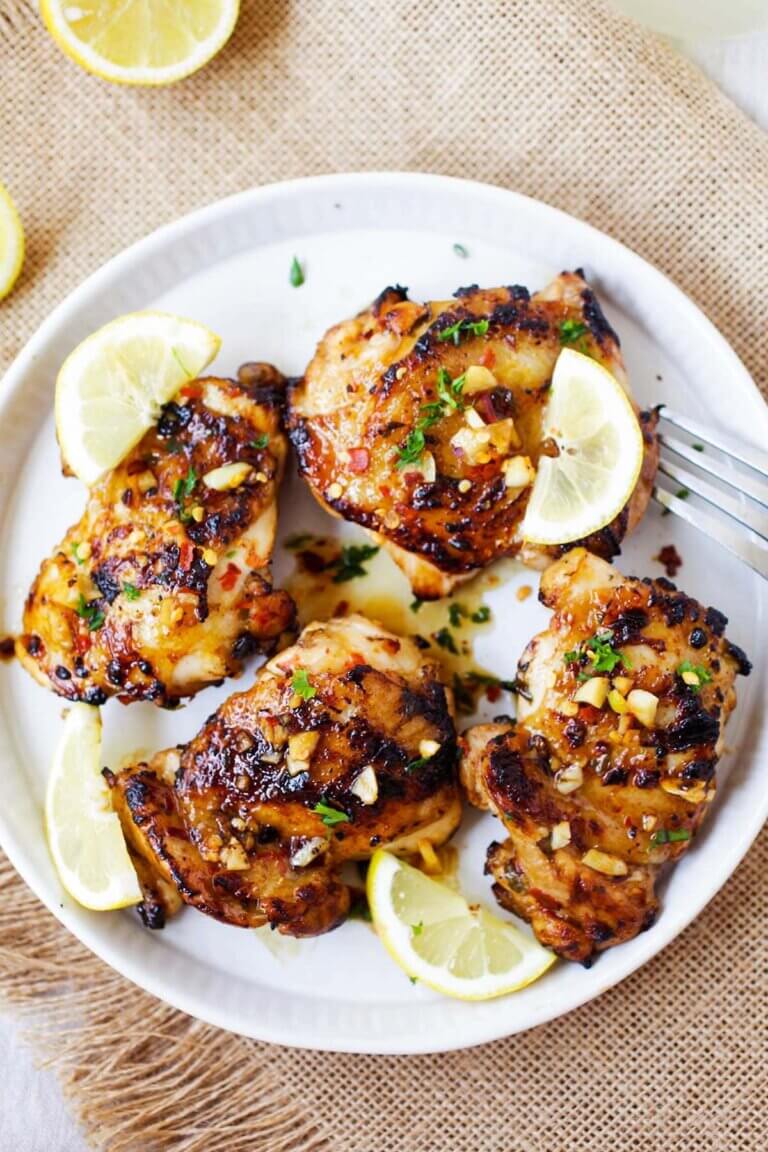
Lemon Garlic Chicken
By Bee Yinn Low of Rasa Malaysia. Updated August 14, 2021
What You Need
- 1 pound boneless, skinless chicken thighs
- Sliced lemons, set aside
MARINADE
- 3 cloves minced garlic
- 2 1/2 tablespoons lemon juice
- 1 teaspoon lemon zest
- 2 tablespoon olive oil
- 1 tablespoon honey
- 1/4 teaspoon paprika
- 1/4 teaspoon chili flakes
- 1/4 teaspoon ground cumin (optional)
- 1 pinch salt
- 3 dashes ground black pepper
- 1 tablespoon chopped Parsley leaves
What You Do
- Mix all the marinade ingredients in a bowl and whisk to combine well. Marinate the chicken in a bowl or a sealable plastic bag for 30 minutes, or best for 2 hours.
- Fire up the grill and grill the chicken on both sides, until it’s cooked through, and the skin is charred. You may bake the chicken in an oven at 400°F (207°C) for about 15-20 minutes, or pan-fried on a skillet on medium to low heat. Serve the chicken warm with some lemon wedges.
Sources
- https://www.thekitchn.com/whats-the-difference-between-olive-oil-and-extra-virgin-olive-oil-word-of-mouth-218767
- https://static.oliveoiltimes.com/library/ioc-olive-oil-standard.pdf
- https://pubmed.ncbi.nlm.nih.gov/32147453/
- https://exauoliveoil.com/blogs/olive-oil/smoke-point#:~:text=There%20are%20different%20grades%20of,is%20390%20%2D%20470%C2%B0F
